Teleport Atlas started as a static export. Next.js 16 with the App Router, output: 'export' in next.config.ts, copy written into the React components, deployed to Vercel as HTML and assets. It was built from a Figma file as a coding challenge, and the build itself is covered in the Teleport Atlas case study.
The decisions about the content model, and what an author is allowed to change, are in From Figma to Sanity.
The finished integration is seven pieces.
- a Sanity Studio in its own directory, deployed separately
- a Sanity client, configured with a studio URL so visual editing works
defineLive, which returnssanityFetchand a<SanityLive />component- a route at
/api/draft-mode/enablethat Presentation calls to turn draft mode on <VisualEditing />, which draws the click-to-edit overlays- a fetch wrapper that falls back to a snapshot committed to the repo
- a signed webhook at
/api/revalidatethat clears cache tags when content is published
Removing the static export
The static export was originally a security decision. Server Components ran at build time, no Node process handled requests, and CVE-2025-66478, a flaw in the React Server Components protocol, was not an issue. Next.js 16.0.7 fixed that CVE. The project was pinned to 16.2.7, so the fix was already in place by the time I started on Sanity, and static export was no longer protecting against it.
Presentation, Sanity’s visual editing tool, requires a running server to serve draft content. Static export cannot provide one, so output: 'export' was removed and the site moved to a server build on Vercel. trailingSlash stayed on, so existing URLs such as /request-access/ keep their trailing slash, which prevented us from having to add redirects. images.remotePatterns replaced unoptimized with a single-host allowlist for cdn.sanity.io.
The first deploy after that change failed:
Error: The file "/vercel/path0/teleport-application/out/routes-manifest.json" couldn't be found.
vercel.json still declared framework: null with an outputDirectory of out, which is where static export writes and which no longer exists. Setting framework: nextjs and dropping the outputDirectory override fixed it. Vercel’s dashboard also stores its own Output Directory setting, separate from vercel.json. Editing vercel.json in the repo does not change the dashboard setting, so if out had been typed into the dashboard as well, the deploy would have kept failing after the repo was fixed. That setting has to be cleared in the Vercel project settings.
Two projects, two package managers
The Studio is a separate directory at the git root, installed with npm and its own lockfile. The app uses pnpm.
They are split because of the app’s supply-chain settings. Its .npmrc sets minimum-release-age and block-exotic-subdeps. These settings block any packages that were published recently. Sanity ships updates often, so installing the Studio under those same settings would mean fighting the minimum release age on most Sanity releases. The Studio gets its own npm install and its own lockfile, so those settings never apply. The Studio deploys to sanity.studio and never ships to Vercel, so it does not need the same protection the app has.
next-sanity is pinned to 13.1.3, and version 13 is the minimum that works on Next.js 16. On Next.js 16, <SanityLive /> calls revalidateTag in a way that empties the client-side prefetch cache, so Next.js prefetches every visible link again and each of those prefetches re-fetches from Sanity. Sanity measured an average 4x increase in request load on the same app, and 7 to 10x on sites with many routes. The free plan allows 250k API requests a month. At 7x, the same traffic the site was already serving uses up that allowance. 13.1.3 was the newest version old enough to pass the seven-day minimum release age at the time.
next.config.ts also sets experimental.prefetchInlining, which Sanity’s guidance recommends alongside the upgrade. Next.js 16 prefetches each segment of a route as its own request. The option bundles every segment for a route into one response, so a link costs one prefetch request. Shared layout data then gets duplicated across those responses, and Next no longer caches it and reuses it. It needs Next 16.2 or higher.
What Presentation needs before it loads
Presentation is a Studio plugin. It renders the site in an iframe next to the document being edited, and three things have to be set up before the preview pane shows anything.
A CORS origin, with credentials. Every browser origin that talks to the Sanity API needs an entry on the project. This project has four. The origin field accepts * as a wildcard, which would let any origin request data from the project API.
npx sanity cors list
npx sanity cors add https://example.com --credentials
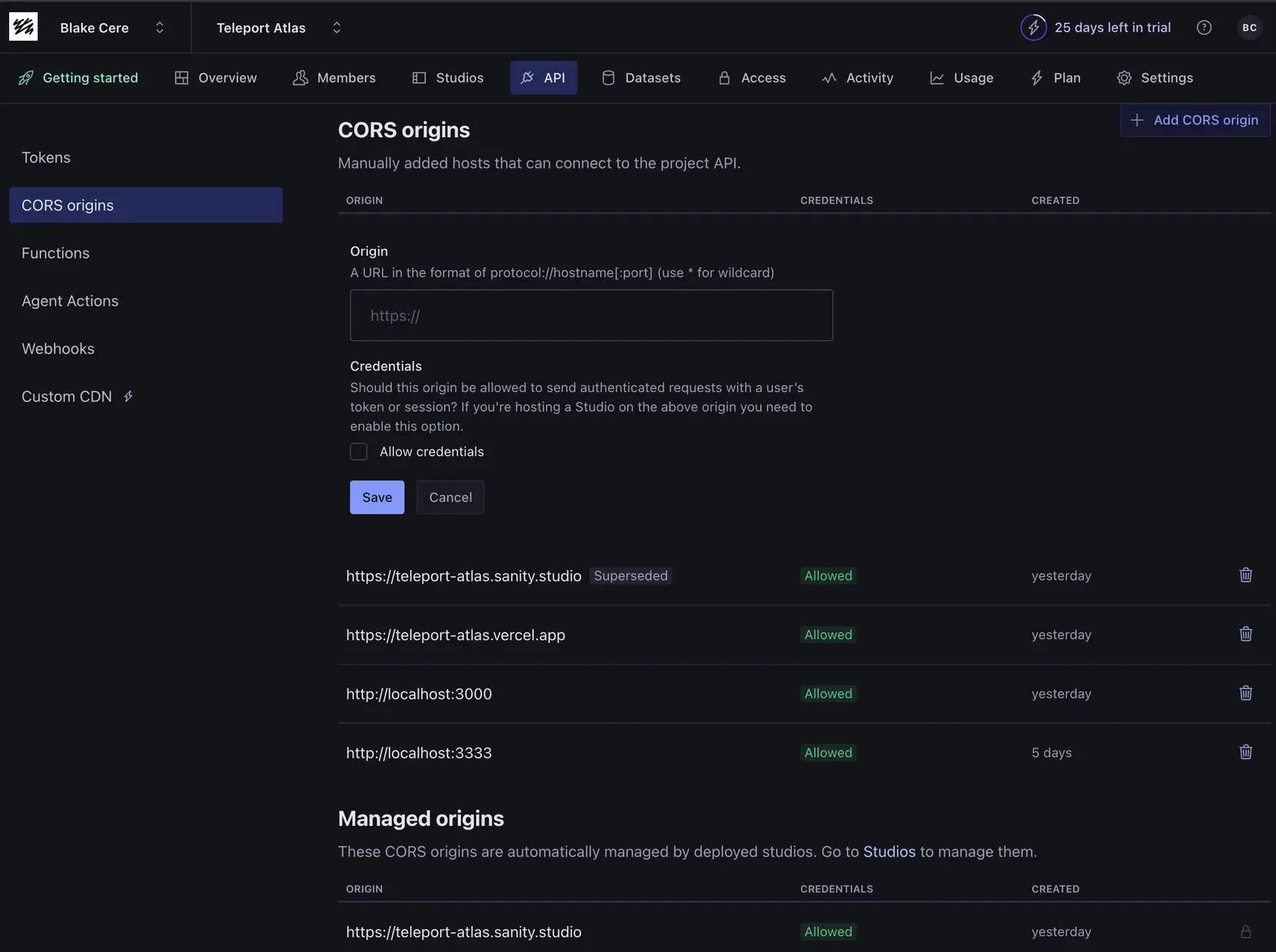
The “Allow credentials” checkbox decides whether that origin may send authenticated requests carrying a user’s token or session. A Studio makes every request as the logged-in user, so an origin hosting a Studio needs the checkbox on. With it off, the Studio itself loads and every request it makes fails.
The Managed origins table below the manual list is filled in automatically by deployed Studios, so the sanity.studio origin is added there, and the other origins are added by hand. If Git-connected previews are ever turned on, the origin to register is the deterministic branch alias, because the per-deployment hashed URL changes every deploy and cannot be registered ahead of time.
A previewUrl pointing at a draft-mode route.
const previewUrl = process.env.SANITY_STUDIO_PREVIEW_URL || 'https://teleport-atlas.vercel.app'

export default defineConfig({
	plugins: [
		structureTool({ structure }),
		presentationTool({
			resolve,
			previewUrl: {
				origin: previewUrl,
				preview: '/',
				previewMode: { enable: '/api/draft-mode/enable' },
			},
		}),
		visionTool(),
	],
})
SANITY_STUDIO_PREVIEW_URL points the Studio at a local dev server instead of production. Whichever origin it holds also has to be in the CORS list above.
The route that previewMode.enable names is six lines.
import { defineEnableDraftMode } from 'next-sanity/draft-mode'
import { client } from '@/sanity/lib/client'
import { readToken } from '@/sanity/lib/token'

export const { GET } = defineEnableDraftMode({
	client: client.withConfig({ token: readToken }),
})
defineEnableDraftMode checks a secret that Sanity generates in the dataset before it enables anything, so a GET without that secret does not turn draft mode on.
No framing header on the site. Both X-Frame-Options and a Content Security Policy frame-ancestors directive stop the browser from loading the site in the Studio’s iframe. next.config.ts sends neither.
curl -sI https://teleport-atlas.vercel.app/ | grep -iE "content-security-policy|x-frame-options"
# expect no output
A frame-ancestors policy that named the Studio origin shipped to production and broke visual editing, after passing a scripted browser test. I wrote that up with the rest of the checks that reported a pass on broken code in Challenges Building the Teleport Atlas Landing Page.
Telling Presentation where a document renders
resolve.ts maps each document to the URL it renders at, and without it Presentation previews the homepage for every document.
export const resolve: PresentationPluginOptions['resolve'] = {
	locations: {
		page: defineLocations({
			select: { title: 'title', slug: 'slug.current' },
			resolve: doc => ({
				locations: [
					{
						title: doc?.title || 'Untitled page',
						href: doc?.slug === 'home' ? '/' : `/${doc?.slug}/`,
					},
				],
			}),
		}),
	},
}
The homepage is served at / and not at /home, so it gets its own case. Every other page follows the [slug] route and keeps the trailing slash that trailingSlash: true produces.
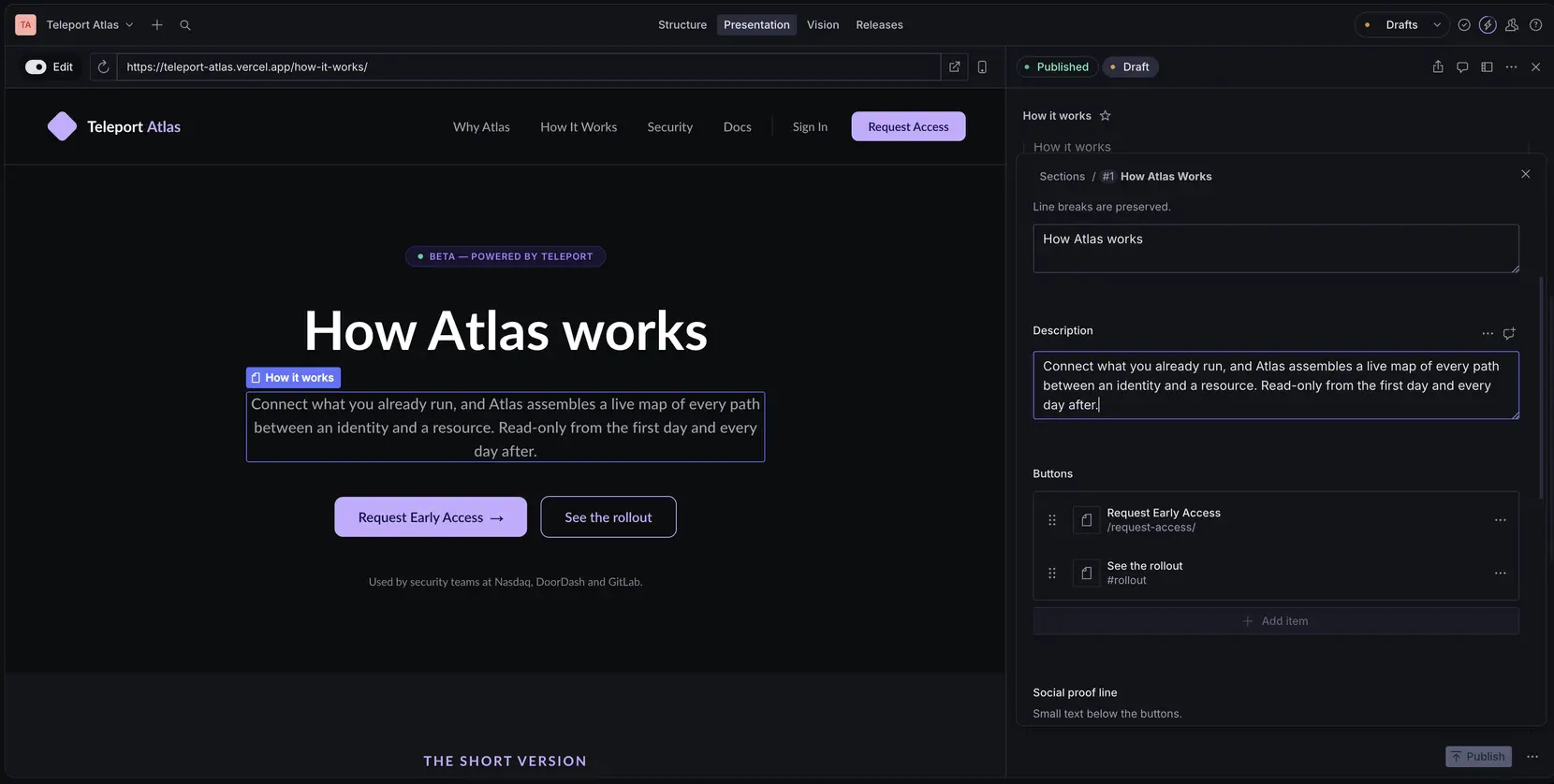
The site settings document renders the nav and footer on every page, so any page would preview it. It resolves to the homepage.
Click-to-edit needs stega.studioUrl
Presentation loaded and live updates worked. Editing a field in the Studio’s structure view updated the preview pane. The click-to-edit overlays did nothing. Selecting text in the preview and editing it there was not possible, so every edit went through the structure view.
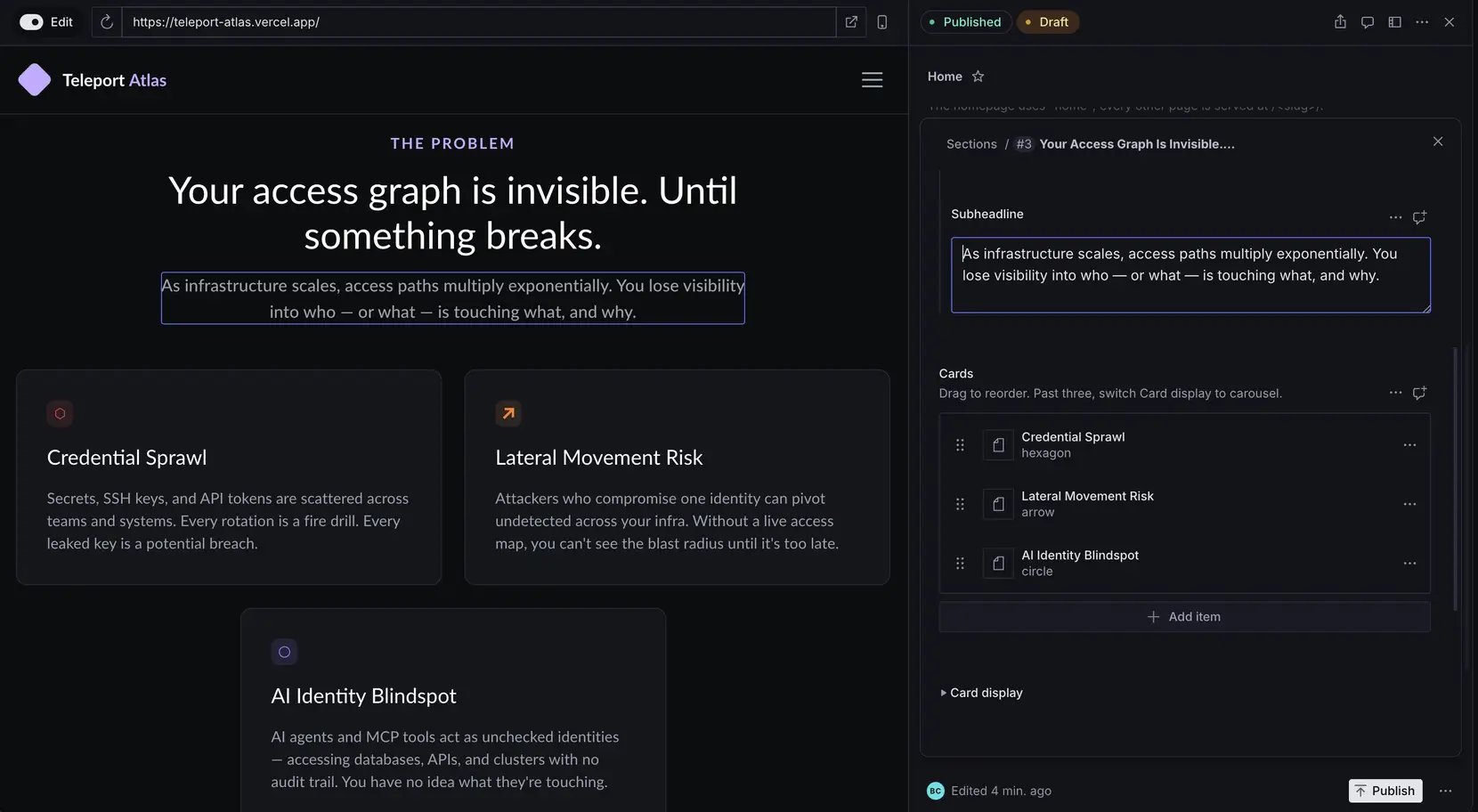
Click-to-edit runs on stega, which is short for steganography. Sanity hides extra data inside the text it sends back. Every string arrives with invisible Unicode characters attached to it, and those characters record which document and which field the text came from. Sanity calls that record a content source map. When you click a piece of text in the preview pane, the overlay reads the map attached to that text to work out which field in the Studio to open.
The cause was a missing stega.studioUrl on the Sanity client. next-sanity decides whether to turn stega on with these two lines:
const studioUrlDefined = typeof client.config().stega.studioUrl !== 'undefined'

const stega = strict ? _stega : (_stega ?? (serverToken && studioUrlDefined ? (await draftMode()).isEnabled : false))
studioUrlDefined is a typeof check on a config value, so it only tests whether the setting exists. With no studio URL configured it is false, and stega stays off even in draft mode. With stega off the strings carry no source map, so the overlay has nothing to read and cannot work out which field produced any piece of text. Nothing errors in that state, which results in a broken overlay.
defineLive does warn in development about a missing serverToken, and again about a missing browserToken. There is no warning for a missing studioUrl.
The fix:
export const client = createClient({
	projectId,
	dataset,
	apiVersion,
	useCdn: true,
	perspective: 'published',
	stega: {
		studioUrl,
	},
})
The stega object takes an enabled flag alongside studioUrl, and this client leaves enabled out. Setting it to true would encode every response the client returns, including the ones a visitor to the public site receives. Leaving it out means defineLive runs the check above on every request, and stega turns on only while draft mode is on. Editors get strings with the invisible characters attached, and visitors get plain ones.
perspective is set explicitly so it does not depend on apiVersion. The default is published from API version 2025-02-19 onward, and raw before that. raw returns drafts and version documents alongside published ones, so moving apiVersion back below 2025-02-19 would start serving drafts on the public page.
Consumed strings need stegaClean()
Turning stega on means the CMS returns strings with invisible characters embedded in them. If you render that string into a paragraph, the characters are invisible and nothing breaks. If you compare that string to something, or use it to look something up, it no longer matches.
Sanity ships a default deny list of field names it never encodes. It holds 39 entries, and five of them turn up on this project.
varianticonhrefsluglayout
The deny list is an exact match on the last key in the path. Alongside those names it also skips several patterns.
- anything nested under
seo,meta,metadata, oropenGraph slug.currentas its own case- any key that starts with
_or ends inId - any string that parses as a date or a URL
So every place the code reads a CMS string had to be checked against the deny list, and the fields the deny list does not cover get cleaned by hand.
background is used to look up a CSS class name. Encoded, the string would match no class name, and every row would render without its background inside Presentation.
const backgroundClass = styles[`section--${stegaClean(background) ?? 'base'}`]
signInHref is not covered, because the deny list holds the exact key href and does not match every key that ends in it. Sanity also skips any string that parses as a URL, and #sign-in is not a valid URL. Encoded, it would produce a broken anchor target.
Six more fields on this project fall outside the deny list. visual decides whether the hero graph renders at all. mediaPosition is another CSS class lookup. alt and a logo’s name are both read out by a screen reader. A card title and a link label are concatenated into an ARIA label.
So call stegaClean() on any string the code reads.
- image
alttext - ARIA labels
- DOM ids
- page metadata
- JSON-LD
- any string used in a comparison or a lookup
The public build emits zero encoded characters, and all seven rows keep their backgrounds.
Moving the copy out of the components
Every projection is written out in full, and none of them are built from shared string fragments. Interpolating a fragment turns the template literal into plain string, and Sanity’s TypeGen keys its query-to-type map on the literal text, so every result would come back typed as {}.
export const PAGE_QUERY = defineQuery(`*[_type == "page" && slug.current == $slug][0]{
	_id,
	title,
	"slug": slug.current,
	seo{title, description, ogImage},
	pageBuilder[]{
		_key,
		_type,
		background,
		anchorId,

		_type == "heroSection" => {
			badgeText,
			headline,
			description,
			socialProof,
			visual,
			ctas[]{_key, label, href, variant, showArrow}
		},

		_type == "trustedBySection" => {
			heading,
			display{layout},
			logos[]{_key, name, href, "src": image.asset->url}
		}
	}
}`)
The query takes the slug as a parameter and is not fixed to the homepage, so adding a page means adding a route file that calls the same query. Logos read asset->url straight through, because they are SVGs and the image pipeline cannot transform SVGs.
The whole [slug] route is thirty lines.
export async function generateStaticParams() {
	const slugs = await getPageSlugs()
	return slugs.filter(slug => !RESERVED_SLUGS.has(slug)).map(slug => ({ slug }))
}

export async function generateMetadata({ params }: Props): Promise<Metadata> {
	const { slug } = await params
	if (RESERVED_SLUGS.has(slug)) return {}
	return buildPageMetadata(await getPage(slug))
}

export default async function DynamicPage({ params }: Props) {
	const { slug } = await params
	if (RESERVED_SLUGS.has(slug)) notFound()

	const page = await getPage(slug)
	if (!page) notFound()

	return <PageBody page={page} />
}
dynamicParams stays at its default of true, so a page created in the Studio after the last deploy still resolves and is rendered on demand the first time it is requested. Adding a page never requires a redeploy.
The read token never reaches the browser
The dataset is public, so reading published content needs no credential. A token is only needed to read drafts under Next.js draft mode.
export const { sanityFetch, SanityLive } = defineLive({
	client,
	serverToken: readToken || false,
	browserToken: false,
})
browserToken stays false. Passing one would give every visitor draft-read access. The token module also starts with import 'server-only', so an accidental client import fails the build.
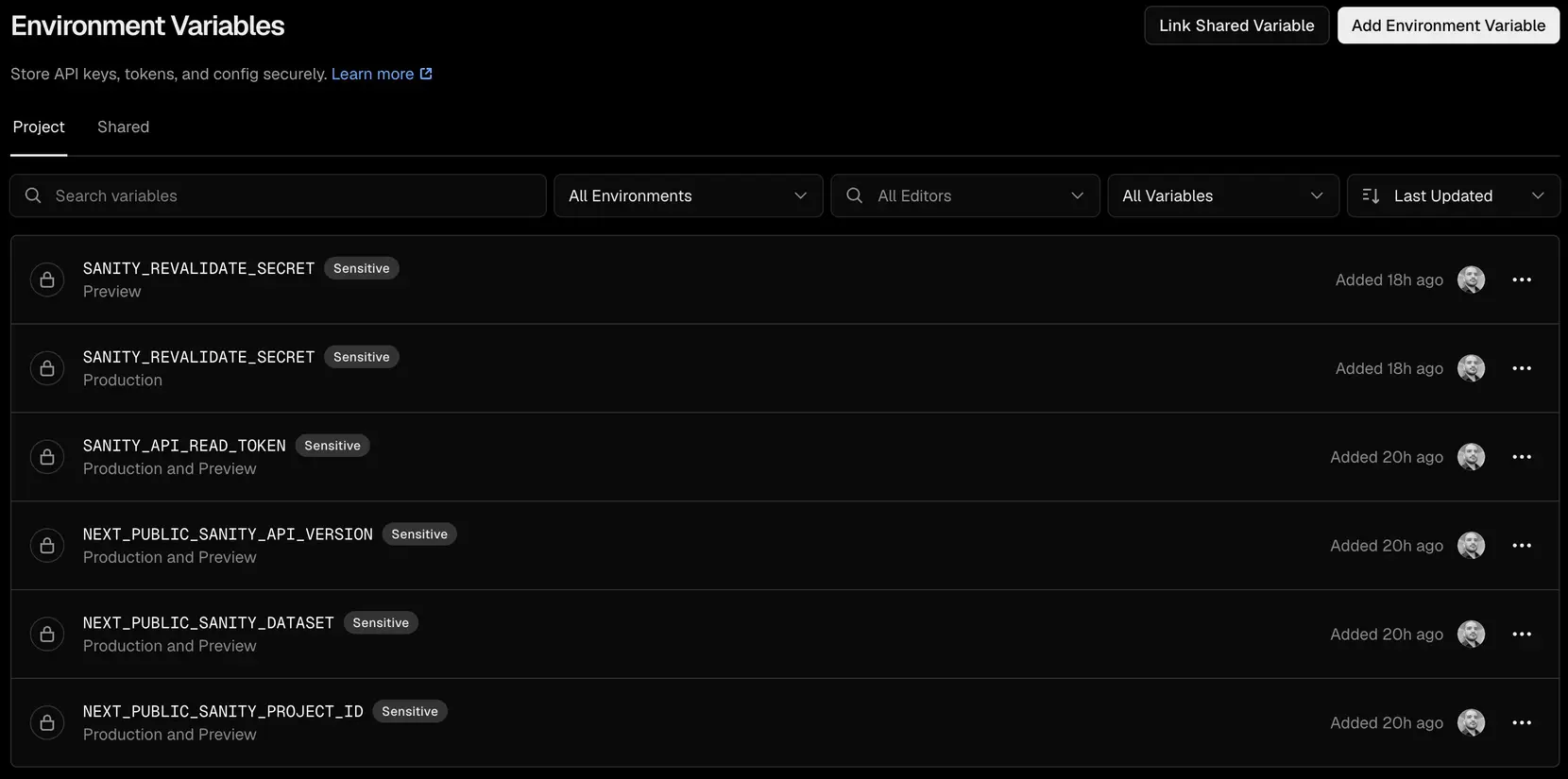
Six variables are set in Production and Preview.
| Variable | Notes |
|---|---|
NEXT_PUBLIC_SANITY_PROJECT_ID |
the project id |
NEXT_PUBLIC_SANITY_DATASET |
production |
NEXT_PUBLIC_SANITY_API_VERSION |
2026-07-01 |
NEXT_PUBLIC_SANITY_STUDIO_URL |
optional, required for click-to-edit, defaults to the hosted Studio |
SANITY_API_READ_TOKEN |
viewer scope, server-only, marked sensitive |
SANITY_REVALIDATE_SECRET |
webhook signing secret, marked sensitive |
CI needs none of them, because the committed content snapshot lets the build succeed with no Sanity configuration.
<SanityLive /> is rendered only under draft mode. On a public page it would open a live connection for every visitor, so the number of requests would go up with traffic, and it would add JavaScript work in the browser. Editors still get instant preview, because Presentation turns draft mode on.
The default refresh handler does not refresh on an edit
Click-to-edit worked once the studio URL was set. Typing into an overlay saved the change to Sanity. The preview pane kept showing the old text until the refresh button was pressed.
<VisualEditing /> ships a default refresh handler that treats its two triggers differently:
case 'manual':
	router.refresh()
	break
case 'mutation':
	console.debug('...provide your own handler to the refresh prop')
	return false
The refresh button is the manual case and works. An edit is the mutation case, which logs and returns false. The default handler is written for setups where <SanityLive /> receives the change over the live connection. A live connection only sends published-content events unless <SanityLive includeDrafts /> is set, and includeDrafts needs a browserToken. Presentation edits are drafts, so no event arrived.
The fix is a refresh prop that handles both triggers with router.refresh(). Refreshing the route avoids <SanityLive includeDrafts />, so no browserToken is needed and the draft-read token stays on the server.
<VisualEditing
	trailingSlash={true}
	refresh={() => {
		router.refresh()
		return new Promise(resolve => setTimeout(resolve, 1000))
	}}
/>
The promise tells Presentation when to stop showing its loading state. router.refresh() reports no completion of its own, so this is the same one-second timer next-sanity’s own handler uses. The wrapper is a client component, because refresh is a function and cannot be passed from the server layout across the RSC boundary.
The same wrapper passes trailingSlash explicitly. Left unset, next-sanity reads process.env.__NEXT_TRAILING_SLASH to guess and logs what it guessed on every render. The prop is marked alpha and subject to change. If the guess is wrong, Presentation loads URLs without the trailing slash, and every one of those URLs returns a 308 redirect.
Rendering <SanityLive /> only in draft mode is what caused the next problem.
Publishing needs a webhook to clear the cache tag
Content was published from the Studio and never appeared on the production URL. The site had a 60-second route revalidation configured, and it had never worked.
sanityFetch hardcodes its cache options:
next: {revalidate: false, tags: cacheTags}
revalidate: false caches every response forever, until something invalidates one of its tags. <SanityLive /> is what normally invalidates those tags, and it only renders in draft mode. Setting revalidate on the route does not help. When the route regenerates, it runs sanityFetch again, which reads the same cached response, so the page rebuilds on a schedule with the same old content every time.
A signed publish webhook replaced the route revalidation. Sanity POSTs to /api/revalidate when a page or siteSettings document is created, updated, or deleted, and the route verifies the signature and invalidates the matching tags.
export async function POST(request: NextRequest) {
	try {
		const { isValidSignature, body } = await parseBody<WebhookPayload>(
			request,
			process.env.SANITY_REVALIDATE_SECRET,
		)

		if (!isValidSignature) {
			return new NextResponse('Invalid signature', { status: 401 })
		}
		if (!body?._type) {
			return new NextResponse('Bad Request', { status: 400 })
		}

		const tags: string[] = []
		if (body._type === 'page') {
			tags.push('page')
			if (body.slug?.current) tags.push(pageTag(body.slug.current))
		} else if (body._type === 'siteSettings') {
			tags.push(TAG_SITE_SETTINGS)
		}

		for (const tag of tags) revalidateTag(tag, 'max')

		return NextResponse.json({ revalidated: tags, type: body._type })
	} catch (error) {
		console.error('[revalidate] webhook failed', error)
		return new NextResponse('Internal Server Error', { status: 500 })
	}
}
Sanity hashes a secret into the webhook request headers, and parseBody from next-sanity/webhook checks it. An unsigned or mis-signed request gets a 401 before anything is invalidated.
revalidateTag takes two arguments in Next 16, where the second is a cache-life profile. 'max' marks the tag stale rather than expiring it, so the next visitor to a page carrying that tag gets the old response while Next fetches the new one in the background. Sanity’s Next.js 16 guidance recommends 'max' here. Next’s own documentation points webhooks that need the entry gone immediately at { expire: 0 } instead, and calling revalidateTag with one argument is deprecated.
sanityFetch sets revalidate: false only while cacheComponents stays off in next.config.ts. With it on, Next resolves a different next-sanity entry point that caches through cacheLife.
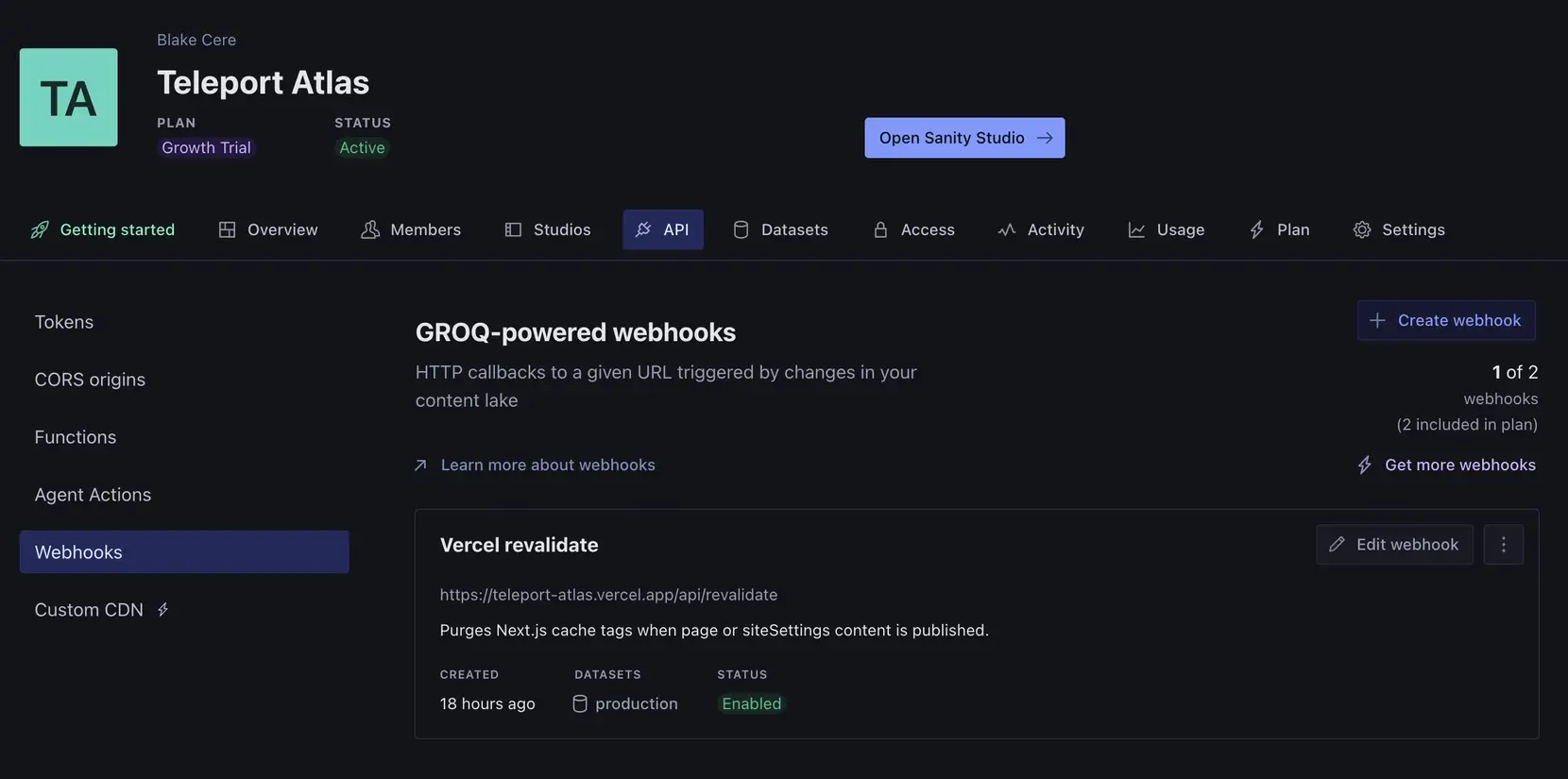
The webhook is also cheaper than rendering <SanityLive /> on public pages. The number of requests goes up with how often you publish. Traffic does not affect it. Testing this against production, a publish showed up on a page I was polling in five to ten seconds with no redeploy.
The site builds with no Sanity credentials
Sanity’s Content Lake only runs on their servers. Deleting the project or revoking its keys would fail the build and take the site down.
So every page read calls getPage(), which wraps sanityFetch. If the fetch fails, or if there is no Sanity configuration, we fall back to a snapshot of the content committed to the repo and render that.
export async function getPage(slug: string): Promise<PAGE_QUERY_RESULT> {
	if (hasSanityConfig) {
		try {
			const { data } = await sanityFetch({
				query: PAGE_QUERY,
				params: { slug },
				tags: ['page', pageTag(slug)],
			})
			if (data) return data
		} catch (error) {
			console.warn(`[sanity] page "${slug}" fetch failed, using committed snapshot`, error)
		}
	}
	return snapshot.pages[slug] ?? null
}
The snapshot is generated by running the same queries against the live dataset, so it matches the generated types. A fresh clone with no environment variables builds and renders every page. CI needs no secrets, which also means pull requests from forks build.
One bug only showed up in a build with no Sanity configuration. createClient and the image URL builder both throw an error when the project ID is empty, so a build with no configuration crashed before it ever got to the fallback. Both now get a placeholder project ID when there is no configuration. Neither createClient nor the image URL builder is called in that kind of build.
The fallback was running on every build
getPageSlugs() feeds generateStaticParams, and it was written the same way as getPage(). It calls Sanity, catches any error, and returns the snapshot. Every build ended up in the catch block.
sanityFetch calls draftMode(). Next throws on draftMode() inside generateStaticParams, because that runs at build time with no request behind it. So the throw happened on every build, the catch block returned the snapshot, and the list of pages to prerender always came from the committed snapshot and never from the live dataset.
Every page still rendered. dynamicParams stays at its default of true, so a page created since the last snapshot still resolved on first request. It was rendered on demand every time and never prerendered, and the only signal was one line from console.warn in the build output.
The fix is to use the plain client for that one read. That read does not need draft mode, stega, or a cache tag, and the client is already pinned to perspective: 'published'.
How the conversion was checked
Moving the copy into Sanity meant pulling the text out of every component and passing it back in as props. The markup and the CSS were supposed to come through unchanged.
- capture the DOM of the deployed build
- capture the DOM of the local build
- normalize the CSS-module hashes, which differ between builds
- diff the two
The first run reported no differences, because a next dev server from an earlier run still held the port the check was reading. Once that was corrected, the diff found two differences that had passed the type checker and the linter. Section headers had lost their header landmark, and a position: relative was left on every row that nothing depended on. That check, and five others that reported a pass on broken code, are in Challenges Building the Teleport Atlas Landing Page.
The four failures
Three of these produced no output at all. The fourth wrote a warning to the build log.
- Click-to-edit gave no warning about the missing studio URL.
- Edits saved and the preview kept showing old text, because the default refresh handler logged instead of refreshing.
- The cache served old content on a timer that looked like it was configured correctly.
- The slug list came from a committed snapshot on every build, because a
try/catchswallowed a throw that happened every time.
No tool in this project’s CI reports any of those. Finding them took three things.
- publishing content and watching for it to appear
- diffing the DOM against the deployed build
- reading the
next-sanitysource to find out when stega turns on and what its refresh handler does
What the conversion required
Removing output: 'export' is the change the rest of the work followed from. Once the site ran on a server, draft mode worked, and every piece around it had to be set up by hand.
- a CORS origin with credentials, and no framing header, so Presentation can load the site at all
- the studio URL, so the click-to-edit overlays can resolve a field
resolve.ts, so opening a document previews that document’s page- a refresh handler, so a draft edit updates the preview
- a signed webhook, so published content reaches the site
stegaClean(), so the strings the code reads still match
browserToken stays false, which keeps the draft-read token on the server. getPage() and getPageSlugs() both fall back to a snapshot committed to the repo, which keeps the build working with no credentials. Each one writes a warning to the build log and then returns content, so the build succeeds and every page renders. That is how the slug list came from the snapshot on every build while the build still succeeded.
Content now publishes without a deploy, and the site still builds from a fresh clone with no environment variables.